Martin Luther King Jr. was only 39 when he was assassinated. In barely 13 years of public life he led a movement that dismantled legal segregation in the United States, won voting rights for millions of Black Americans and gave the world some of the most powerful words ever spoken about justice. He also saw the struggle of Black Americans as part of a worldwide movement for freedom, closely linked to Africa’s fight against colonialism and apartheid.
At a glance
- Born: 15 January 1929, Atlanta, Georgia, United States
- Died: 4 April 1968, Memphis, Tennessee
- Field: Civil rights, religion, human rights
- Known for: Leading the civil rights movement; the “I Have a Dream” speech (1963); Nobel Peace Prize 1964
A preacher’s son
King was born in Atlanta, in the segregated American South, where Black people were barred from white schools, restaurants, hotels and swimming pools, and were systematically prevented from voting. His father and grandfather were Baptist ministers. He entered Morehouse College at 15, went on to study theology, and earned a doctorate from Boston University in 1955. Along the way he studied the philosophy of non-violence, including the work of Mahatma Gandhi.
Montgomery
In 1954, King became pastor of the Dexter Avenue Baptist Church in Montgomery, Alabama. In December 1955 a Black seamstress and activist, Rosa Parks, was arrested for refusing to give up her bus seat to a white passenger. Local leaders organised a boycott of the city’s buses and chose the 26-year-old King to lead it.
The Montgomery bus boycott lasted more than a year. Black residents walked, shared cars and organised their own transport. King’s home was bombed and he was arrested, but the boycott held. In late 1956, the US Supreme Court upheld a ruling that bus segregation was unconstitutional. The victory made King a national figure. In 1957 he helped found the Southern Christian Leadership Conference to coordinate non-violent campaigns across the South.
A Pan-African outlook
In March 1957, King travelled to Accra to attend Ghana’s independence celebrations as a guest of Kwame Nkrumah. He was deeply moved and later preached that Ghana’s freedom showed that oppressed people could win. In the years that followed, he regularly linked the American struggle to African independence movements. In 1962 he joined Chief Albert Luthuli of South Africa in issuing an appeal for international action against apartheid, and he continued to call for economic pressure on the apartheid regime.
Birmingham and Washington
In 1963, King led a campaign in Birmingham, Alabama, one of the most segregated cities in America. Police used fire hoses and dogs against peaceful protesters, including children, and the images shocked the world. Jailed for defying a court order, King wrote his “Letter from Birmingham Jail”, a powerful defence of non-violent direct action. He argued that injustice anywhere is a threat to justice everywhere, and that people could not wait forever for rights that were theirs.
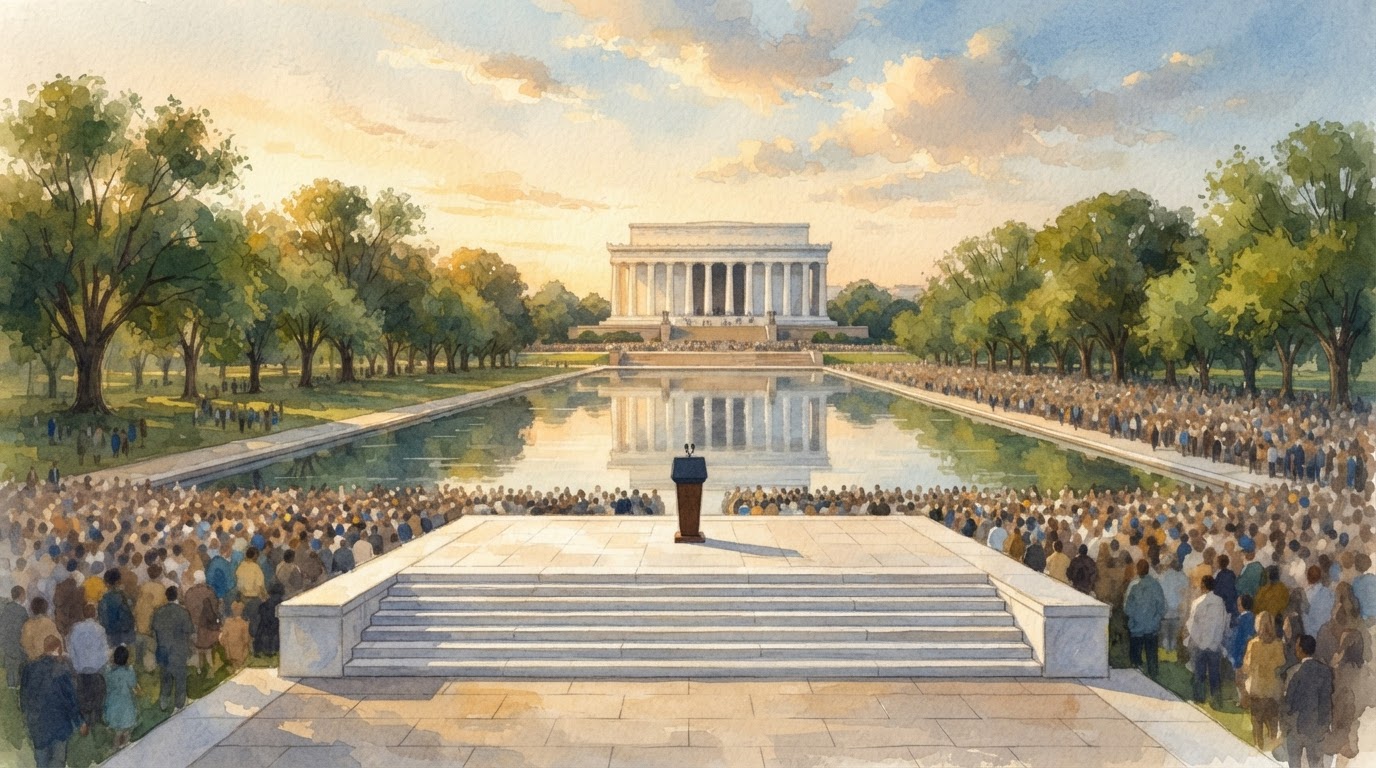
On 28 August 1963, around 250,000 people gathered for the March on Washington for Jobs and Freedom. Speaking from the steps of the Lincoln Memorial, King described his dream that his four children would one day live in a nation where they would be judged not by the colour of their skin but by the content of their character. The speech became one of the most famous in history.
Laws that changed America
The movement’s pressure helped pass the Civil Rights Act of 1964, which outlawed segregation in public places and discrimination in employment. That year, aged 35, King became the youngest person at the time to win the Nobel Peace Prize. In 1965, marches from Selma to Montgomery in Alabama, during which state troopers brutally attacked peaceful marchers, led to the Voting Rights Act, which removed many of the barriers that had stopped Black Americans from voting.
Beyond civil rights
In his final years, King widened his focus to poverty and war. In April 1967 he publicly opposed the Vietnam War, a decision that cost him support among allies and the government. He began organising a Poor People’s Campaign to demand jobs and economic justice for Americans of all races. He was also under constant surveillance by the FBI, which tried to discredit him.
On 4 April 1968, while supporting striking sanitation workers in Memphis, Tennessee, King was shot dead on the balcony of the Lorraine Motel. His death sparked grief and unrest across the country. The day before, he had told an audience that he had seen the promised land, even if he might not get there with them.
Why he matters
King’s legacy is often softened into a gentle message about dreams and unity. The real King was more radical. He challenged racism, poverty and militarism together, and he believed that true peace required justice, not just the absence of conflict. He was deeply unpopular with many Americans when he died.
For Africa and its diaspora, King’s life offers lessons that remain current: the power of organised, disciplined mass action; the importance of linking struggles across borders; and the courage to speak uncomfortable truths to the powerful. In 1983, the United States created a national holiday in his honour. His words are quoted from Accra to Johannesburg to London, wherever people still march for dignity.
Leave a Reply