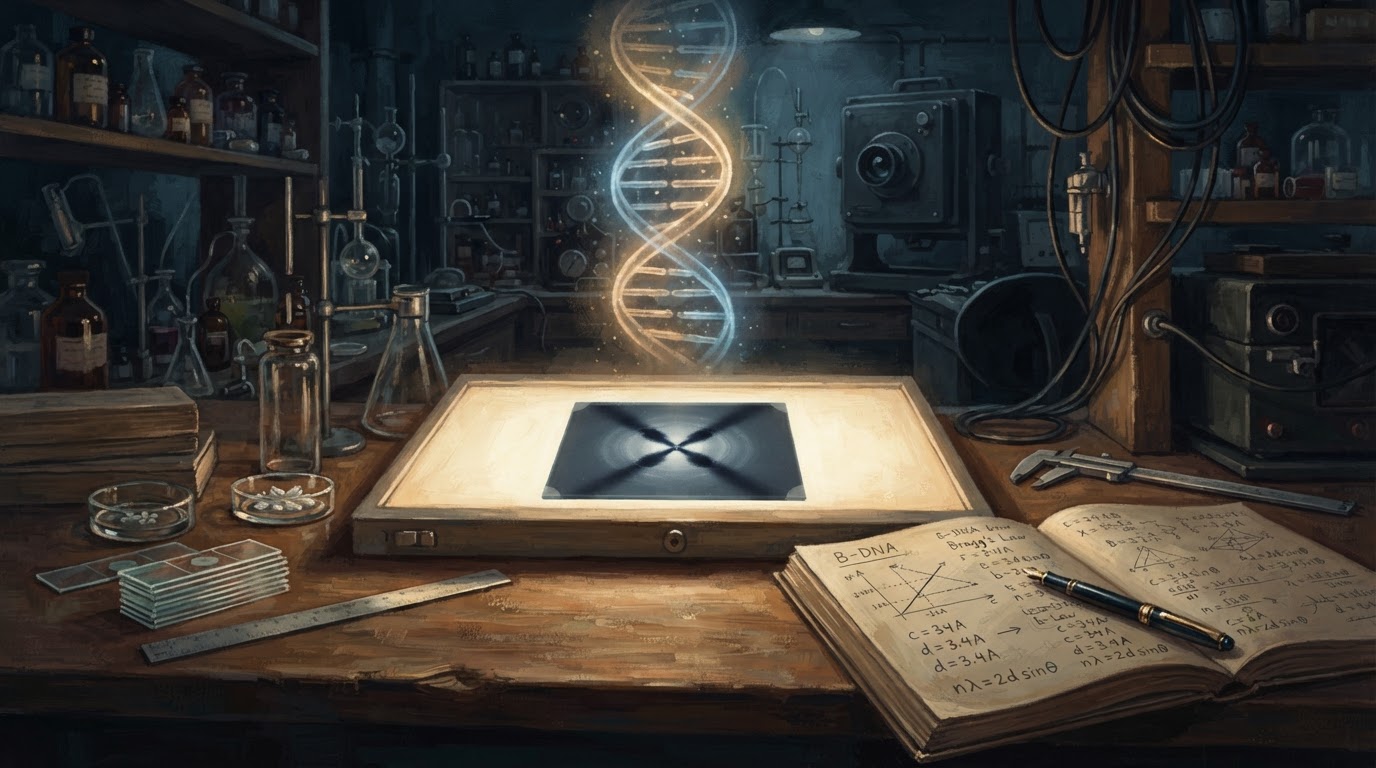
In 1953, James Watson and Francis Crick announced that DNA, the molecule that carries genetic information, is shaped like a twisted ladder: the double helix. It was one of the most important scientific discoveries of the twentieth century. But their model depended heavily on the work of a scientist whose contribution was, for many years, barely acknowledged. Rosalind Franklin’s X-ray images and measurements provided crucial evidence for the structure. She died at 37, four years before the Nobel Prize was awarded for the discovery.
At a glance
- Born: 25 July 1920, London, England
- Died: 16 April 1958, London
- Field: Chemistry, X-ray crystallography, molecular biology
- Known for: X-ray images of DNA, including “Photo 51”; pioneering research on coal and virus structures
A determined young scientist
Franklin was born into a prominent Jewish family in London. She decided at school that she wanted to be a scientist, at a time when few women entered the field. She studied natural sciences at Newnham College, Cambridge. During the Second World War she researched the structure of coal for the British Coal Utilisation Research Association. Her work helped explain why some types of coal turn into graphite when heated, and earned her a doctorate in 1945.
She then spent three happy years in Paris, at a French government laboratory, where she became an expert in X-ray crystallography. This technique fires X-rays at a material and records how they scatter. From the patterns, scientists can work out how atoms are arranged.
King’s College and DNA
In 1951 Franklin joined King’s College London to work on DNA. Scientists knew DNA carried genetic information but not how it was structured. From the start there was confusion about her role. She believed she had been put in charge of the DNA X-ray work; her colleague Maurice Wilkins believed she had come to assist him. The two clashed, and the atmosphere was tense. Franklin also faced the everyday sexism of British science in the 1950s.
Working with PhD student Raymond Gosling, Franklin refined her methods and discovered that DNA existed in two forms, which she called A and B. In May 1952 they produced an exceptionally clear image of the B form, later known as Photo 51. Its distinctive X-shaped pattern strongly suggested a helix. Franklin’s careful measurements also showed that the phosphate backbone of DNA was on the outside of the molecule.
How her work was used
Meanwhile, at Cambridge, Watson and Crick were trying to build a model of DNA. In January 1953, Wilkins showed Watson Photo 51, without Franklin’s knowledge. Watson later wrote that his mouth fell open when he saw it. Crick also gained access to a research report containing Franklin’s data. These insights were critical in helping them build their model.
In April 1953 the journal Nature published three papers together: Watson and Crick’s model, a paper by Wilkins and colleagues, and a paper by Franklin and Gosling. Franklin’s data appeared to support the model, but readers were not told how much the model had depended on her work.
Viruses and an early death
Franklin left King’s soon afterwards and moved to Birkbeck College in London. There, she led important research on the structure of viruses, including the tobacco mosaic virus, and began work on the polio virus. Her colleague Aaron Klug later won a Nobel Prize for work that built on their collaboration.
In 1956 she was diagnosed with ovarian cancer. She continued working through her treatment. She died in April 1958, aged 37.
The Nobel Prize
In 1962, Watson, Crick and Wilkins shared the Nobel Prize in Physiology or Medicine for discovering the structure of DNA. The Nobel Prize is not awarded posthumously, so Franklin could not have been included. Whether she would have been, had she lived, is still debated.
Her reputation was further damaged by Watson’s 1968 memoir, The Double Helix, which portrayed her unfairly as difficult and unattractive. Later biographies, and accounts by colleagues who knew her, restored the picture of a meticulous, brilliant and warm scientist. In recent decades she has become a symbol of the many women whose scientific contributions were overlooked.
Why she matters
Understanding DNA has transformed medicine, agriculture and criminal justice. It underpins genetic testing, modern vaccines and research into diseases that affect Africa heavily, such as sickle cell disease, malaria and HIV. African scientists are now leading major genome projects, revealing that Africa holds the greatest human genetic diversity on Earth.
Franklin’s story is also about fairness in science: who gets credit, who gets heard and who gets left out. It is a question that still matters for women in science everywhere, and for African researchers whose work is too often used by others without equal recognition. The European Space Agency named its Mars rover after her. That is fitting for a scientist who saw what others could not.
Leave a Reply