Category: Football

Football news and analysis: African football, AFCON, African players in Europe, the Premier League and the World Cup.

  • Liverpool 4-0 Manchester United: Early Red Card Sinks Ten-Man United at Anfield

    Liverpool 4-0 Manchester United: Early Red Card Sinks Ten-Man United at Anfield

    The biggest fixture in English football was effectively over inside a quarter of an hour. Manchester United had a player sent off after eight minutes, Liverpool scored twice in the next five, and Anfield spent the rest of Sunday afternoon enjoying a 4-0 win over their oldest rivals.

    Both clubs came into the game under pressure. Liverpool had lost at home to Manchester City and Arsenal in recent weeks, and their recovery at Crystal Palace last Sunday needed confirming. They got the confirmation in the most emphatic way possible.

    Thirteen minutes that decided it

    The red card in the eighth minute changed everything. United had set up to frustrate Liverpool and hit them on the break through Bryan Mbeumo and Matheus Cunha. With ten men, that plan was gone before it had started.

    Liverpool punished them at once. The opener came on ten minutes and the second three minutes later, with Florian Wirtz and Dominik Szoboszlai pulling the strings from midfield and Alexander Isak leading the line. United made a change as early as the 22nd minute to try to stem the bleeding, and another at half-time.

    No way back

    The second half followed the same pattern. Liverpool kept the ball, United chased it. The third goal arrived in the 66th minute, a minute after United made a double substitution, and the fourth came eight minutes from time.

    With the game won, Liverpool made five changes in the final 20 minutes to rest players for the busy weeks ahead.

    The numbers

    LiverpoolMan Utd
    Possession63%37%
    Shots2711
    Shots on target124
    Corners155
    Fouls148
    Cards1 yellow1 red

    The figures tell the story of a one-sided afternoon. Twenty-seven shots and fifteen corners show how relentlessly Liverpool attacked. Senne Lammens made eight saves in the United goal, without which the score could have been heavier. To United’s credit, they still managed four shots on target with ten men, but they never seriously threatened a comeback.

    What it means

    For Liverpool, this is a second straight Premier League win and a timely boost before a hectic run of fixtures: the Merseyside derby at Everton next Sunday, then Sunderland at home on Wednesday and a trip to Chelsea the following Saturday. The questions about their form after defeats to City and Arsenal have not gone away, but this was a statement.

    For United, it is a painful afternoon. Discipline cost them the game before it had really begun. They must regroup quickly, and the debate about whether this squad is good enough to compete at the top will only grow louder.

    The African angle

    Few fixtures are watched more closely across Africa than Liverpool against Manchester United. From Harare to Lagos to Nairobi, pubs and viewing centres were packed. Cameroon international Bryan Mbeumo had little chance to make an impact once his side went down to ten men. Liverpool fans across the continent will be celebrating tonight; United supporters will be hoping for a much better response in their next match.

    Read our pre-match preview and more in our Football section.

  • Asia’s Champions League: Big Money, Bigger Ambitions, and Africa’s Stake in It

    Asia’s Champions League: Big Money, Bigger Ambitions, and Africa’s Stake in It

    Asia’s top club competition returns this week. The AFC Champions League Elite reaches its fifth round of league-stage matches on 23 and 24 November. This season it has 32 clubs in the main competition, the first time since 2019 that the tournament has been that large.

    Saudi Arabia’s dominance

    Al-Ahli of Saudi Arabia are the two-time defending champions, having retained the title in 2026. Saudi clubs have spent heavily over the past few years, and Asia’s premier competition is where that spending is meant to show. Al Hilal, Al-Nassr, Al-Ittihad and Al-Qadsiah are all involved this season.

    Money does not guarantee results, though. Earlier in the league stage, Al Ain of the UAE won 4-1 away to Al-Ittihad in Jeddah. Japan’s Kashima Antlers beat Australia’s Newcastle Jets 7-1. East Asian clubs, particularly from Japan and South Korea, remain well-organised and tactically strong.

    Why Africa should watch

    Gulf football has become an important destination for African players. Big contracts in Saudi Arabia, the UAE and Qatar have drawn established internationals and younger players alike. Their performances in this competition affect their national teams, their market value and their chances of moving to Europe.

    There is a policy question too. The Gulf’s investment in football has created competition for African talent. It offers players a better salary than many African leagues can match, but often at a lower sporting level than Europe’s top divisions. For African federations, the challenge is ensuring that players who go to the Gulf remain sharp enough for international duty.

    The comparison with CAF

    Asian club football has also outpaced Africa in prize money and broadcast reach. CAF has improved its prize money, with the Champions League winner now receiving a record US$6 million. But the gap remains large. Africa has the talent. What it lacks is the commercial structure to keep more of it at home.

    The final will be played on 1 May 2027. We will keep an eye on the knockout rounds, especially any clubs with strong African contingents.

  • The Road to the 2030 World Cup Starts Now, and Africa Has a Host

    The Road to the 2030 World Cup Starts Now, and Africa Has a Host

    The 2026 World Cup in North America is barely in the rear-view mirror, and the next one is already taking shape. The 2030 tournament, the centenary World Cup, will be played from 8 June to 21 July 2030. It will be hosted mainly by Spain, Portugal and Morocco, with opening games in Uruguay, Paraguay and Argentina to mark the anniversary of the first World Cup.

    Morocco’s moment

    For Africa, the headline is simple. Morocco will be the first African country to host World Cup matches since South Africa in 2010, and they qualify automatically as co-hosts. That frees up a qualification place for another African nation, assuming CAF’s allocation follows the 2026 model.

    Morocco reached the semi-finals in 2022, the first African team to do so. They have also become the continent’s most consistent side, as their perfect AFCON qualifying record this autumn shows. Playing a World Cup partly at home gives them a real chance to go further than any African team has gone before.

    How the others are qualifying

    Several confederations have already announced their plans. UEFA will use a new two-tier system modelled on its club Champions League format. Each team will play six matches against six different opponents. Concacaf has announced six direct places and a seventh possible through the intercontinental play-off, with no automatic entries for the 2026 hosts this time.

    FIFA has not yet formally confirmed the number of places for each confederation. There is also a proposal from CONMEBOL to expand the 2030 tournament to 64 teams. If that were accepted, every qualifying format would change dramatically.

    What Africa needs

    For the 2026 tournament, Africa received nine direct places, with a tenth possible via the intercontinental play-off. CAF used a single group stage of nine groups of six, which gave every nation a meaningful path. It worked well, and there is a strong case for repeating it.

    The more important battle is political. Africa is the largest confederation by member countries, but its share of World Cup places has historically been smaller than its size suggests. With Morocco hosting and African teams improving, the continent has a strong argument for keeping, or increasing, its allocation. That case needs to be made firmly at FIFA before the slots are set.

    We will follow the 2030 qualifying announcements as they come. The draw for Africa’s route has not been made, but the work to influence it starts now.

  • Hardrock: Champions at the First Attempt, and What It Says About Zimbabwean Football

    Hardrock: Champions at the First Attempt, and What It Says About Zimbabwean Football

    Kwekwe has its first top-flight championship. On Saturday at Chahwanda Stadium, Hardrock FC beat FC Platinum 1-0 on the final day to win the 2026 Castle Lager Premier Soccer League in their very first season in the division. They finished two points clear of the defending champions, Scottland.

    Prince Dube, the former SuperSport United striker, scored the only goal in the first half. Kelvin Kaindu’s side then held on through a tense closing stretch with ten men. At Gibbo, Scottland did their part by beating Triangle United 2-1, but they needed Hardrock to slip, and Hardrock did not.

    A title that nearly got away

    This could have been settled a fortnight ago. Hardrock were held 0-0 by Simba Bhora before the international break, while Scottland beat Herentals 4-0 and cut the gap to two points. That pushed the race to the final day. For a club with no top-flight history, the two weeks of waiting were a real test of nerve. They passed it.

    Kaindu said from the start that the aim was the title, not survival. That ambition looked naive in March. Hardrock played their first home league match against the reigning champions in a newly built stadium and drew 0-0. They then kept collecting points while bigger names stalled. Dynamos, the country’s best-supported club, fell out of the race in the closing weeks.

    The new map of Zimbabwean football

    Look at the last three champions: Simba Bhora in 2024, Scottland in 2025, and now Hardrock. These are newer, well-funded clubs, not the old Harare and Bulawayo giants. The Herald notes that only Black Rhinos in 1984 and Scottland last year had previously won the title as newcomers. Two of the three such cases have now come in consecutive seasons.

    There are two ways to read this. The optimistic view is that money is reaching football outside the traditional power centres. That brings new stadiums, professional coaching and better-paid players to towns like Kwekwe. The cautious view is that titles are increasingly bought rather than built. Clubs that rise quickly on one backer’s money can fall just as quickly when that backer loses interest. Zimbabwean football has seen this before.

    The truth probably sits between the two. What matters now is what Hardrock do with the title. The champions are expected to represent Zimbabwe in the CAF Champions League. Zimbabwean clubs have struggled there for years, held back by weak finances, travel costs and stadiums that often fail CAF inspection. Chahwanda is new. If it meets CAF’s standards, Hardrock could play continental football at home in Kwekwe, which would be a meaningful step for the domestic game.

    What comes next

    Scottland coach Peter Ndlovu has already said his side are not finished. They still want to return to the African stage. That rivalry, between two new clubs with serious backing, is likely to define the next few seasons.

    For now, the story belongs to Kwekwe. Ask any supporter of a small-town club whether a title like this is possible, and the honest answer used to be no. Hardrock have changed that answer.

  • AFCON 2027 Qualifiers: Morocco and Senegal Cruise, Algeria and Egypt Stumble

    AFCON 2027 Qualifiers: Morocco and Senegal Cruise, Algeria and Egypt Stumble

    The 2027 Africa Cup of Nations will be played in Kenya, Uganda and Tanzania, the first time East Africa has hosted the tournament jointly. The November qualifying window, played as back-to-back fixtures between the same opponents, has now settled the first places, and it has told us a good deal about who is in form.

    Morocco: perfect and through

    Morocco beat Niger 5-1 and then 1-0, making it four wins from four and 12 points in Group A. They are through with two rounds still to play. No surprise there. Morocco are the continent’s most consistent team and the benchmark for everyone else.

    Senegal also qualified. They beat Sudan 4-1 and 4-2, reaching 10 points, and other results in Group K confirmed a top-two finish. Ethiopia’s late 1-0 win in Mozambique, settled by Canaan Markneh’s 87th-minute goal, was one of the shocks of the window.

    The giants who wobbled

    Algeria beat Togo 1-0 at home and then lost 3-0 in Lomé, with Thibault Klidje scoring twice. They still lead Group E on 7 points, but only one point ahead of Togo. A team of Algeria’s quality should not be in this kind of race.

    Egypt won 5-0 against Malawi and then were held 0-0 in Lilongwe. That left them second in Group B on 8 points, two behind Angola. Egypt will still be expected to qualify, but the draw is a reminder that away trips in African qualifying remain hard regardless of reputation.

    Nigeria are in more trouble. They beat Tanzania 3-1 but then drew 0-0, leaving them three points behind Guinea-Bissau, who lead Group D on 10. For a country with Nigeria’s talent, needing results in March is a poor return. Tunisia are bottom of Group H on 3 points after a 1-1 draw in Libya.

    What this tells us

    Three things stand out. First, the gap between Africa’s top teams and the rest keeps narrowing. Guinea-Bissau, Angola, Togo and Libya are all ahead of more famous names in their groups. Better coaching, more players in European leagues and stronger domestic structures are spreading quality more evenly across the continent.

    Second, the double-header format punishes complacency. Several big teams won comfortably at home and then failed to repeat it away days later. That says as much about travel, pitches and conditions as it does about quality.

    Third, the March 2027 window will be dramatic. Nigeria, Algeria, Egypt and Tunisia all have work to do. At least one big name is likely to miss the tournament. For a competition that is supposed to celebrate African football, that is not bad news. It means the qualifiers count.

    Southern African results, including Bafana Bafana and the Warriors, are covered in a separate piece in our Football section today.

  • Bafana, the Warriors and Southern Africa’s AFCON Push

    Bafana, the Warriors and Southern Africa’s AFCON Push

    Southern Africa’s footballing reputation has often rested on a handful of teams: South Africa, Zambia and, on its best days, Zimbabwe. The November AFCON 2027 qualifiers offered mixed news for all three, and a reminder that the region still cannot take results for granted.

    South Africa: top of the group, but work to do

    Bafana Bafana drew 2-2 with Kenya at home and then won 2-1 in Kenya. That second result matters. Kenya are co-hosts and already qualified, but beating them away is never easy. South Africa now lead Group F on 10 points, one ahead of Guinea.

    Bafana should qualify. The home draw, though, shows a familiar weakness: conceding cheap goals when in control. South Africa has the strongest domestic league on the continent and a settled coaching set-up. With that base, the target should be more than qualification. It should be a real run at the title in East Africa.

    Zimbabwe: frustration, then a response

    The Warriors were held 0-0 away in Equatorial Guinea and then won the return match 3-0. That is exactly the response a team needs after a frustrating first leg. Zimbabwe’s national team has suffered for years from poor administration and money problems off the pitch. A convincing win changes the mood around the squad.

    There is a wider point here too. The Zimbabwean league has just produced an exciting new champion in Hardrock, and newer clubs are investing in facilities. If that domestic energy can be turned into a stronger national team, the Warriors could become competitive again rather than merely hopeful.

    Zambia and Mozambique caught out

    Zambia drew 1-1 at home to Burundi after Jean Girumugisha’s late equaliser in front of a full stadium. Mozambique lost 1-0 at home to Ethiopia. Both results show how dangerous it is to assume home wins against lower-ranked teams. Angola, meanwhile, beat South Sudan 2-0 and lead Group B ahead of Egypt.

    The regional picture

    Southern Africa should be sending several teams to East Africa. The region has the continent’s richest league, a large talent pool and some of its best stadiums. Yet too often its national teams underperform the resources around them. The difference between the region and North and West Africa is not talent. It is consistency, organisation and the willingness of federations to plan beyond the next fixture.

    The final qualifiers are in March 2027. South Africa can secure their place then. Zimbabwe will need more wins like Monday’s to join them.

  • CAF Champions League: The Group Stage Starts Next Weekend, and It Is Stacked

    CAF Champions League: The Group Stage Starts Next Weekend, and It Is Stacked

    Africa’s elite club competition resumes next weekend. The CAF Champions League group stage kicks off on 27-29 November, with 16 clubs in four groups of four. The top two in each group reach the quarter-finals. The winners will collect a record US$6 million.

    The groups

    • Group A: Esperance (Tunisia), Petro Atlético (Angola), FC Nouadhibou (Mauritania), Wiliete (Angola)
    • Group B: Zamalek (Egypt), Young Africans (Tanzania), MC Alger (Algeria), Club Africain (Tunisia)
    • Group C: RS Berkane (Morocco), Simba (Tanzania), Orlando Pirates (South Africa), Colombe Sportive (Cameroon)
    • Group D: Pyramids (Egypt), Al Hilal (Sudan), Horoya (Guinea), Maghreb Fès (Morocco)

    Group B is the heavyweight

    Group B has five-time champions Zamalek, MC Alger, Club Africain and Young Africans. That brings together Egyptian, Algerian and Tunisian giants with one of East Africa’s biggest clubs. Two good teams will go out here. Yanga have spent heavily, including signing Peter Shalulile from Mamelodi Sundowns, and they will believe they can make the knockouts.

    Pirates’ tricky draw

    For South African fans, Group C is the one to watch. Orlando Pirates face RS Berkane, one of Morocco’s strongest recent clubs, and Simba, who have strong home support in Dar es Salaam. Colombe Sportive of Cameroon complete the group. Pirates have the quality to qualify, but they will need to take points on the road.

    The Confederation Cup

    Africa’s second competition also starts the same weekend. Al Ahly, the continent’s most successful club, find themselves in Group A with Raja Casablanca, ASKO Kara and Primeiro de Agosto. South Africa’s Durban City are in Group B with AS FAR of Morocco, Azam of Tanzania and Al Ahly Tripoli of Libya. That is a big test for a club still building its continental experience.

    The bigger picture

    Look at the draw as a map and a pattern appears. North African clubs are spread across every group. Tanzania has four clubs in the two group stages, a sign of real investment in Tanzanian football. Southern Africa has Pirates in the Champions League and Durban City in the Confederation Cup.

    Prize money has improved, but it still does not cover the true cost of travel across a continent of 54 countries. Until CAF solves that problem, club football in Africa will continue to reward the richest clubs most. Next weekend, though, is about the football. We will follow every round.

  • Nations League: England Win in Spain, and the Last Eight Is Set

    Nations League: England Win in Spain, and the Last Eight Is Set

    The league phase of the 2026/27 UEFA Nations League ended on Tuesday. Eight teams go into two-legged quarter-finals in March 2027, with the winners going to the finals in June.

    The quarter-finalists

    Group winners: France, Germany, England, Portugal.
    Runners-up: Belgium, Netherlands, Spain, Norway.

    England’s statement in Spain

    England beat Spain 3-2 away last Sunday to top Group A3. It was revenge for a 3-2 home defeat to the same opponents on matchday one. Winning in Spain against the European champions is a real marker for Thomas Tuchel’s side. Jude Bellingham finished the league phase as its top provider of assists, with six.

    Germany’s five, the Dutch collapse

    Germany beat the Netherlands 5-0 last Monday. The Dutch had beaten Greece 7-0 only days before, which shows how unpredictable this tournament can be. Both still qualified. Germany won the group; the Netherlands finished second.

    Haaland finishes the job

    Norway won 3-2 in Copenhagen to take second place in Group A4 ahead of Denmark. Erling Haaland scored twice, including a stoppage-time penalty, and Martin Ødegaard also scored. Portugal, the holders, won the group after beating Wales 3-2 in Cardiff. Their earlier 4-1 home defeat to Denmark had briefly made the group look open.

    France and Belgium

    France won Group A1 with 13 points after beating Türkiye 2-1. Belgium took second with 12, helped by a 4-1 win over Italy. Italy missed out on the quarter-finals on 10 points.

    Why African fans should care

    European international football is full of players with African heritage, and several of these squads depend on them. The Nations League also shapes UEFA’s thinking on World Cup qualifying for 2030, where a new format is being introduced. Strong performances here influence seeding and confidence ahead of that cycle.

    The quarter-final ties will pair group winners with runners-up from different groups, with the winners hosting the second leg. They will be played between 25 and 30 March 2027.

  • Bundesliga and Ligue 1: Dortmund Unbeaten, PSG Survive Nice

    Bundesliga and Ligue 1: Dortmund Unbeaten, PSG Survive Nice

    Germany: Dortmund lead, Bayern slip

    Borussia Dortmund won 1-0 at Borussia Mönchengladbach on Saturday and remain unbeaten at the top of the Bundesliga on 24 points. Bayern Munich were held 1-1 at home by Köln and sit second on 22, level with Freiburg. RB Leipzig are fourth on 21 after a 5-1 win at Union Berlin.

    • Bayern 1-1 Köln
    • Gladbach 0-1 Dortmund
    • Union Berlin 1-5 Leipzig
    • Leverkusen 4-0 Paderborn
    • Elversberg 0-1 Freiburg
    • Frankfurt 1-0 Hoffenheim
    • Schalke 0-0 Stuttgart

    Dortmund’s position is the story. Germany usually ends with Bayern on top, and few people outside Dortmund will bet against that happening again. But an unbeaten run into late November gives Dortmund belief, and Bayern’s home draw shows they are not untouchable. Freiburg’s place among the leaders is a credit to one of Europe’s best-run clubs. Gladbach are bottom on four points.

    France: PSG win a thriller

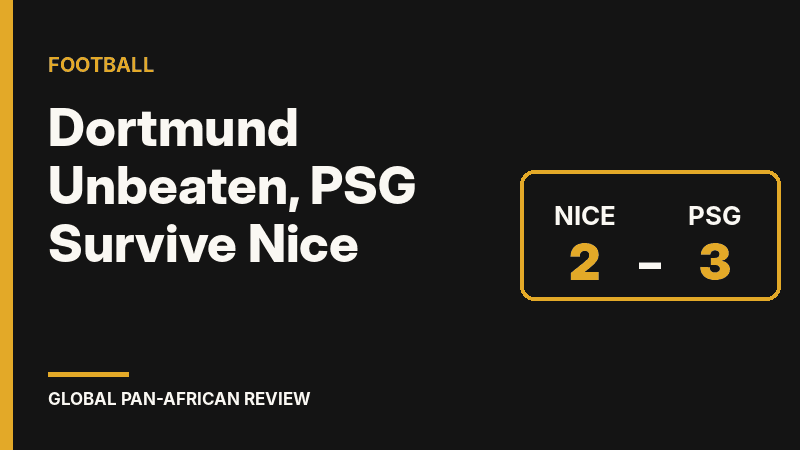
    Paris Saint-Germain won 3-2 at Nice to stay top of Ligue 1 on 26 points, five clear of Lille. Conceding twice away from home is not ideal for the champions. But they found a way to win, which is what keeps them ahead.

    • Nice 2-3 PSG
    • Lille 0-1 Lyon
    • Monaco 1-1 Auxerre
    • Strasbourg 0-1 Brest
    • Troyes 3-1 Le Havre

    Lille’s home defeat to Lyon was a missed opportunity. Lyon are now level with Paris FC on 20, one behind Lille. Paris FC’s rise is one of the most interesting stories in France, giving the capital a second serious club. Le Havre are bottom with just two points.

    The African angle

    Ligue 1 remains the European league most closely tied to African football. Many of the continent’s national team players, especially from North and West Africa, play or developed in France. When African coaches pick their AFCON squads next year, French football will supply a large share of the names.

  • South Africa’s Betway Premiership: Sundowns Ahead, Pirates Chasing

    South Africa’s Betway Premiership: Sundowns Ahead, Pirates Chasing

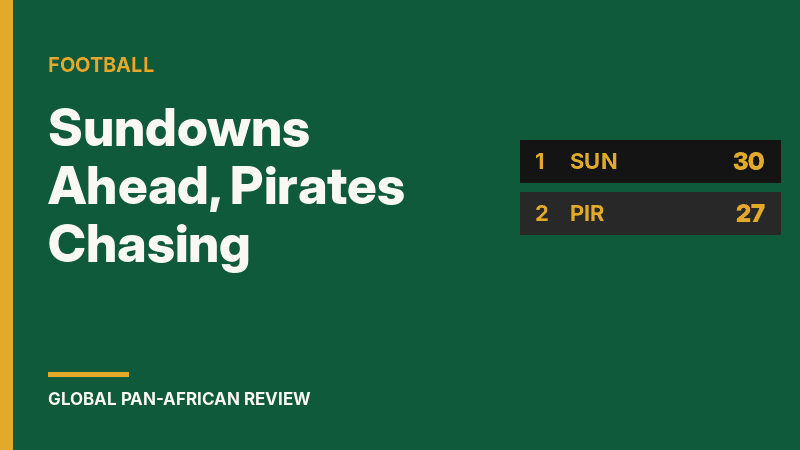
    South African football’s familiar order is back. On the latest SuperSport log, Mamelodi Sundowns lead the Betway Premiership with 30 points from 11 matches: ten wins and one defeat. Orlando Pirates are second on 27, with nine wins from 11.

    A two-club race again

    Sundowns have dominated South African football for most of the past decade. They have won the league title more often than anyone in the PSL era. The question each season is not whether they will challenge, but whether anyone can stop them. Pirates are the only side currently keeping pace.

    Pirates also won the Soweto derby at the start of the month, handing Kaizer Chiefs their first league defeat of the season. The derby remains one of the most balanced rivalries in African football. Across 61 PSL-era league meetings, each side had won 18 before that game, with 25 draws.

    Chiefs’ long wait

    Kaizer Chiefs have the country’s largest fan base and the weight of history. What they have not had for years is a league title. The derby defeat was a reminder that being hard to beat is not the same as being a title team. Chiefs need wins, not just a good unbeaten record.

    The continental factor

    The next few weeks bring a heavy schedule. Pirates start their CAF Champions League group campaign next weekend against RS Berkane, Simba and Colombe Sportive. Durban City begin in the Confederation Cup. Continental football demands long trips and squad rotation, and it often costs clubs points at home.

    That gives Sundowns a potential advantage if they are not carrying the same continental load. Pirates will need squad depth to compete on two fronts. If they can, the title race could stay close well into 2027.

    Our view

    The PSL is Africa’s richest domestic league. It pays better than most, has strong broadcast coverage and attracts players from across the region. Zimbabwean, Zambian, Malawian and Namibian players are central to many squads. A competitive title race is good for the whole of Southern African football. A Sundowns procession is not. This season, Pirates are giving us a race.