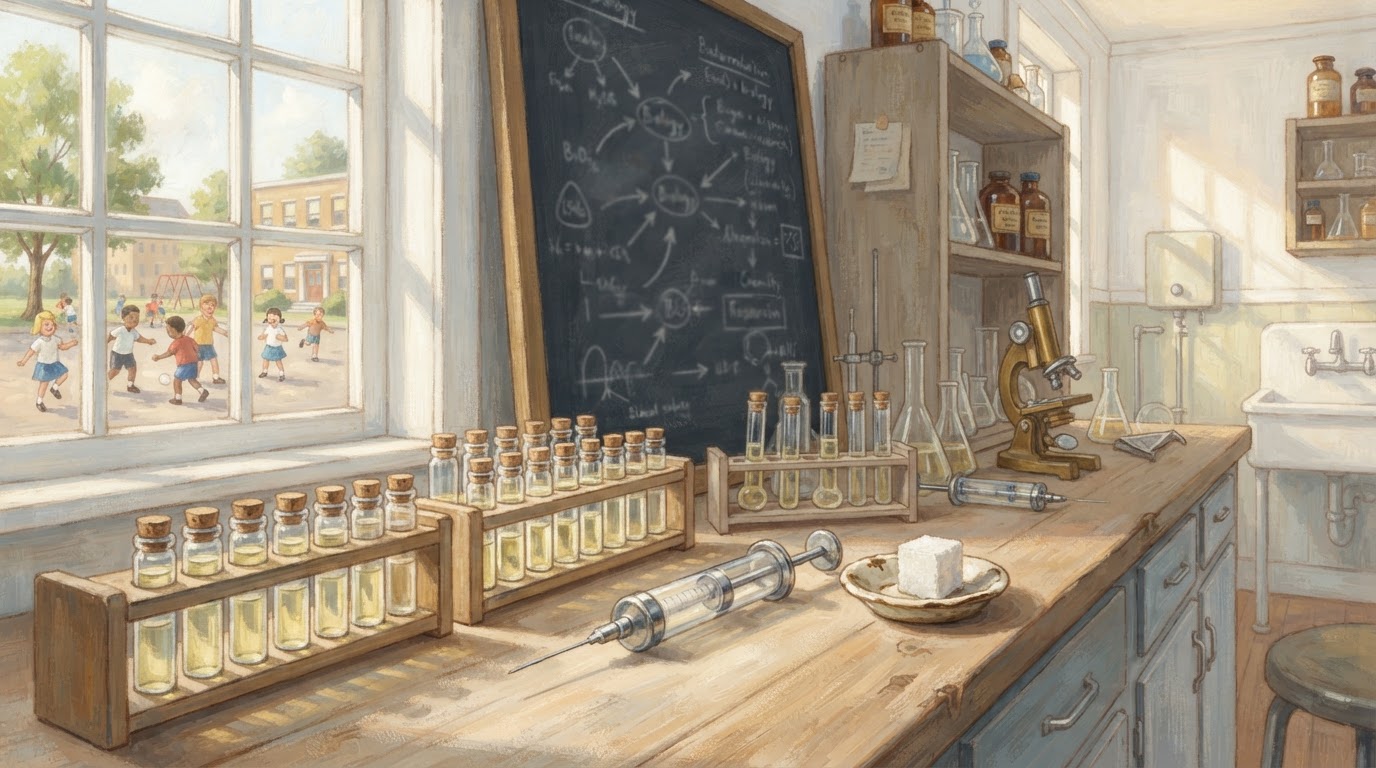
In the early 1950s, polio was one of the most feared diseases in the world. Every summer, parents kept children away from swimming pools and cinemas, terrified that they might catch a virus that could paralyse them for life or leave them unable to breathe without an “iron lung”. Then, in April 1955, came news that a vaccine developed by Dr Jonas Salk was safe and effective. Church bells rang across the United States. Asked who owned the patent, Salk replied that there was none. Could you patent the sun?
At a glance
- Born: 28 October 1914, New York City, United States
- Died: 23 June 1995, La Jolla, California
- Field: Medicine, virology
- Known for: Developing the first successful polio vaccine (announced 1955); founding the Salk Institute
From immigrant family to medical research
Salk was born in New York City to Jewish immigrant parents from Eastern Europe. Neither had much formal education, but they pushed their sons to study. He went to the City College of New York and then to New York University’s medical school. He chose research over private practice because he wanted to help humanity on a larger scale than one patient at a time.
During the Second World War he worked at the University of Michigan with his mentor, Thomas Francis Jr, on an influenza vaccine for the US army. That work taught him a key idea: a vaccine could be made from a virus that had been killed, rather than a weakened live one, and it could still train the immune system to recognise the real thing.
The race against polio
In 1947, Salk set up his own laboratory at the University of Pittsburgh. With funding from the National Foundation for Infantile Paralysis, known for its “March of Dimes” fundraising campaign, he joined the effort to classify the different types of polio virus. Researchers confirmed there were three types, so an effective vaccine would have to protect against all of them.
The urgency was enormous. In 1952, the United States recorded its worst polio epidemic, with tens of thousands of cases. Salk’s team grew polio virus in monkey kidney cells and inactivated it with formaldehyde. He tested it on himself, his wife and his three sons, among others, before wider trials.
The largest medical trial in history
In 1954, a massive field trial began, organised by Thomas Francis. Around 1.8 million children, called “Polio Pioneers”, took part as vaccine recipients, placebo recipients or observed controls. It was the largest medical experiment the world had seen.
On 12 April 1955, Francis announced the results: the vaccine was safe, effective and potent. Salk became a national hero overnight. Mass vaccination began almost immediately.
A setback and a lesson
Within weeks, disaster struck. One manufacturer, Cutter Laboratories, produced batches in which the virus had not been fully inactivated. Thousands of children were infected, some were paralysed and some died. The “Cutter incident” led to much tighter government regulation of vaccine production, standards that protect people around the world today. The vaccination programme resumed, and polio cases in the United States fell dramatically.
Salk and Sabin
A few years later, Albert Sabin developed an oral polio vaccine using a weakened live virus. It was cheaper and easier to give, often on a sugar cube or as drops, and it became the main tool for mass campaigns in many countries. The two scientists were rivals for years. Both vaccines have played essential roles, and today global strategy uses them together.
Later life
Salk used his fame to found the Salk Institute for Biological Studies in La Jolla, California, which opened in the 1960s and remains one of the world’s leading research centres. In his final years he worked on a vaccine against HIV. He died in 1995, aged 80.
Africa’s victory over wild polio
The fight that Salk began continued long after his death. In 1988 the Global Polio Eradication Initiative was launched, when polio paralysed around 350,000 children a year worldwide. Huge vaccination campaigns followed. In Africa, community health workers, traditional leaders and volunteers travelled to remote villages and conflict zones, sometimes at great personal risk.
In August 2020, Africa was certified free of wild poliovirus, one of the great public health achievements in the continent’s history. Nigeria, once a global hotspot, made particularly remarkable progress. Outbreaks of vaccine-derived polio still occur where vaccination coverage is low, so the work is not finished.
Why he matters
Salk’s vaccine saved countless children from paralysis and death. But his decision not to patent it carries a message just as important. During the COVID-19 pandemic, African countries waited months for vaccines while richer nations bought up supplies, and debates over patents and fair access became central. Salk’s view, that life-saving medical discoveries belong to humanity, remains a standard against which the global health system can be judged.
Leave a Reply