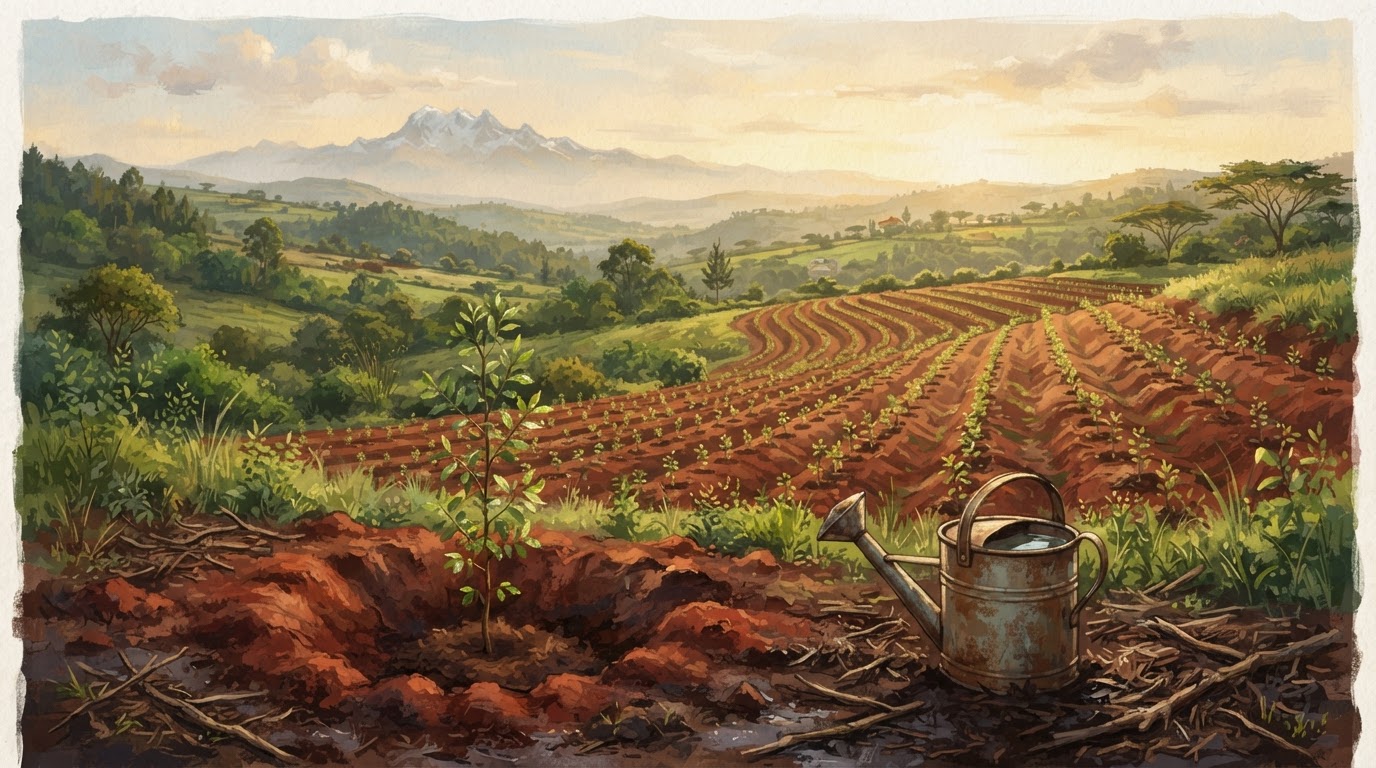
Wangari Maathai started with a simple idea: if rural women planted trees, they would have firewood, clean water and healthier soil. That idea grew into the Green Belt Movement, one of Africa’s most successful environmental campaigns. Along the way, Maathai became a scientist, a politician, a fierce critic of authoritarian rule and, in 2004, the first African woman to win the Nobel Peace Prize.
At a glance
- Born: 1 April 1940, Ihithe, Nyeri District, Kenya
- Died: 25 September 2011, Nairobi
- Field: Environment, science, human rights, politics
- Known for: Founding the Green Belt Movement; Nobel Peace Prize 2004
Growing up in the highlands
Maathai grew up in the central highlands of Kenya, among streams, fig trees and fertile farmland. Her mother sent her to school at a time when few girls in rural Kenya received an education. She excelled, and in 1960 she was one of around 300 young Kenyans selected for scholarships to study in the United States, a programme often called the “Kennedy Airlift”.
She earned a degree in biology from Mount St Scholastica College in Kansas and a master’s degree from the University of Pittsburgh. Back in Kenya, she completed a doctorate at the University of Nairobi in 1971, becoming the first woman in East and Central Africa to earn a PhD. She went on to head the university’s department of veterinary anatomy, another first for a woman.
Listening to rural women
Through her work with the National Council of Women of Kenya, Maathai heard the same complaints again and again. Rural women said streams were drying up, firewood was harder to find and food supplies were less secure. Maathai saw the common cause: deforestation. When forests disappeared, soil eroded, water sources dried up and women walked further every day to meet their families’ basic needs.
Her answer was practical. In 1977 she launched what became the Green Belt Movement, paying women a small sum for each seedling that survived. The approach gave women income, restored land and built confidence. The movement has since planted tens of millions of trees across Kenya, and its model spread to other African countries.
Standing up to power
Maathai quickly understood that environmental damage was linked to bad governance. Land grabs, corruption and the lack of accountability all fed deforestation. That put her in direct conflict with the government of President Daniel arap Moi.
In 1989 she led opposition to a plan to build a huge office tower in Uhuru Park, one of the few green spaces in central Nairobi. She was mocked in parliament and publicly attacked, but foreign investors withdrew and the project was abandoned. In the late 1990s she campaigned against the illegal allocation of Karura Forest to private developers. During one protest she and her supporters were attacked and beaten. She was arrested several times over the years, and at times went into hiding.
She also joined campaigns for multiparty democracy and for the release of political prisoners. In 1992 she took part in a hunger strike with mothers of political prisoners at Uhuru Park, where police broke up the protest and she was injured.
Parliament and the Nobel Prize
When Kenya’s political landscape changed in 2002, Maathai was elected to parliament for Tetu constituency with an overwhelming majority. She served as assistant minister for environment and natural resources.
In 2004 the Norwegian Nobel Committee awarded her the Nobel Peace Prize for her contribution to sustainable development, democracy and peace. It was the first time the prize had been given for environmental work, and the committee’s decision made a clear argument: peace depends on how societies manage their natural resources. Competition over land, water and forests drives many conflicts, especially in Africa.
Writing and later life
Maathai wrote several books, including her memoir Unbowed (2006) and The Challenge for Africa (2009), in which she argued that Africa’s problems could not be blamed only on outsiders. She called on African leaders and citizens to take responsibility for governance, cultural identity and the environment.
She also became a voice in international climate talks and served as a goodwill ambassador for the Congo Basin forest ecosystem. She died of ovarian cancer in Nairobi on 25 September 2011, aged 71. At her request, she was cremated rather than buried in a wooden coffin, so that no tree would be cut down for her.
The hummingbird
Maathai often told a story about a forest fire. All the animals stood watching, overwhelmed. Only a tiny hummingbird flew back and forth to a stream, carrying one drop of water at a time. When the larger animals asked what difference it could possibly make, the hummingbird replied that it was doing the best it could. Maathai said she wanted to be like the hummingbird.
Why she matters
Maathai connected things that others treated separately. She showed that the environment is not a luxury issue for rich countries; for millions of African families, it is about food, water, firewood and survival. She showed that ordinary women, often ignored by policy makers, could restore whole landscapes. And she showed that protecting nature sometimes means confronting those in power.
Today, as climate change hits African farmers hardest, her message feels more urgent than ever. Large tree-planting and land-restoration projects across the continent, such as the Great Green Wall across the Sahel, follow a path she helped clear.
Leave a Reply