This is the first profile in our new Biographies section, which tells the stories of people who changed the world for the better over the past hundred years, in every field and from every region.
Few people in modern history have carried as much moral authority as Nelson Rolihlahla Mandela. He spent 27 years in prison and came out not seeking revenge but offering a hand to the people who had jailed him. That choice helped South Africa avoid the civil war many had predicted, and it made him a symbol of freedom far beyond Africa.
At a glance
- Born: 18 July 1918, Mvezo, Eastern Cape, South Africa
- Died: 5 December 2013, Johannesburg
- Field: Politics, human rights, law
- Known for: Leading the struggle against apartheid; South Africa’s first democratically elected president (1994–1999); Nobel Peace Prize 1993
A boy from the Eastern Cape
Mandela was born into the Thembu royal family in the village of Mvezo. His given name, Rolihlahla, is often translated as “pulling the branch of a tree”, or more loosely, “troublemaker”. A teacher at his primary school gave him the English name Nelson, as was common for African children at the time.
After his father died, he was raised under the guardianship of the Thembu regent at Mqhekezweni, where he watched tribal elders settle disputes through long discussion and consensus. He later said this taught him that a leader should listen first and speak last. He studied at the University College of Fort Hare, one of the few institutions open to Black South Africans, and later moved to Johannesburg, where he studied law.
Lawyer and activist
In Johannesburg, Mandela saw the daily humiliations of segregation up close. In 1944 he helped found the African National Congress Youth League, which pushed the ANC towards mass action. When the National Party came to power in 1948 and began building the formal system of apartheid, the stakes rose sharply.
In 1952 Mandela and Oliver Tambo opened South Africa’s first Black-run law firm, defending people charged under apartheid’s pass laws and land rules. The same year he helped lead the Defiance Campaign, in which thousands of people deliberately broke unjust laws. From 1956 he was one of 156 activists tried for treason in a case that dragged on until 1961, when all the accused were acquitted.
From non-violence to armed struggle
The turning point came in 1960, when police at Sharpeville opened fire on unarmed protesters, killing 69 people. The government banned the ANC. Mandela concluded that peaceful protest alone could not defeat a state willing to shoot its citizens, and in 1961 he co-founded Umkhonto we Sizwe (“Spear of the Nation”), the ANC’s armed wing. Its early campaign targeted infrastructure rather than people.
He was arrested in 1962. At the Rivonia Trial, where he faced the possibility of the death penalty, he gave a statement from the dock that ended by saying he cherished the ideal of a free and democratic society and was prepared to die for it. In June 1964 he and several co-accused were sentenced to life imprisonment.
Twenty-seven years
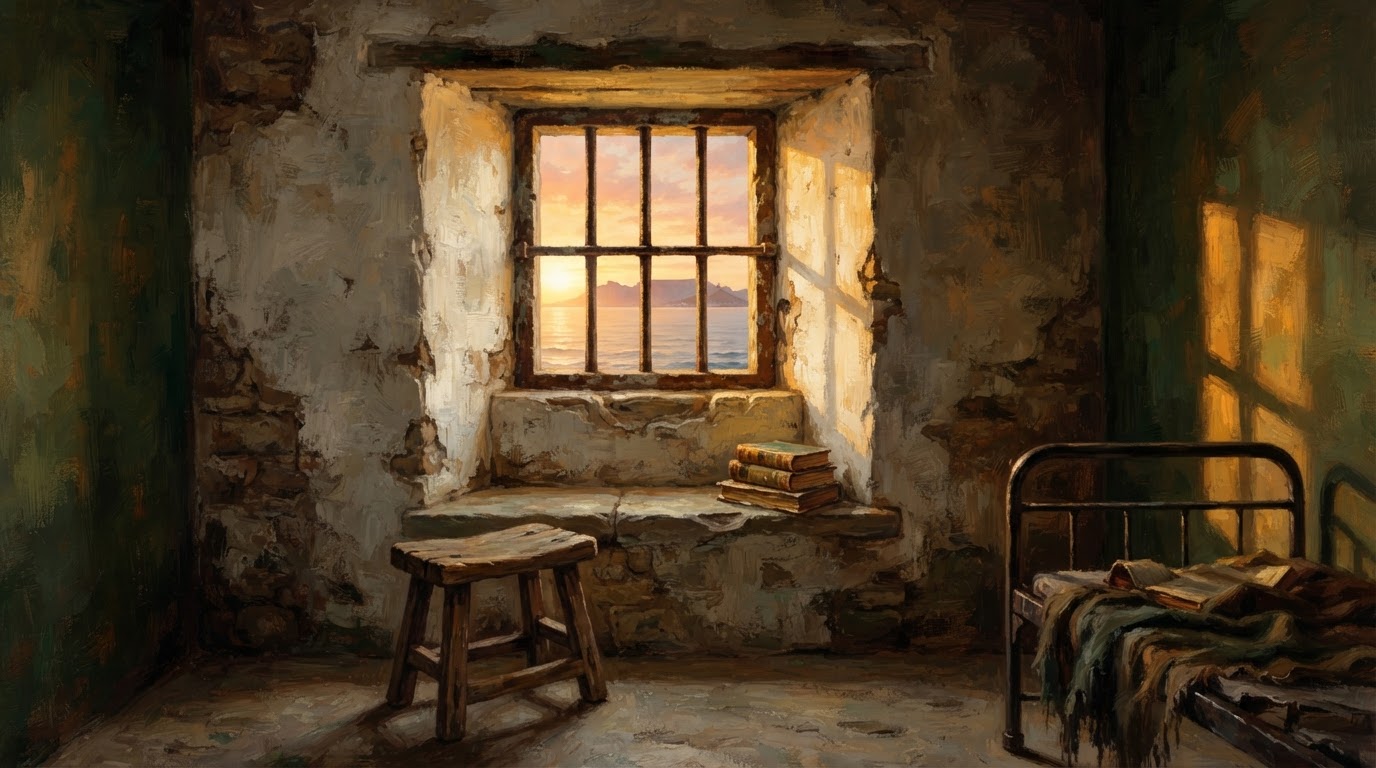
Mandela spent 18 of his 27 years in prison on Robben Island, breaking rocks in a lime quarry and sleeping in a tiny cell. Prisoners turned the island into what they called a “university”, teaching one another history, politics and law. He was later moved to Pollsmoor Prison and then to Victor Verster Prison, where he began secret talks with the government.
Outside, his name became a rallying cry. The international anti-apartheid movement, sanctions, sporting boycotts and resistance within South Africa all built pressure on the regime. African states, especially the Frontline States of Southern Africa, paid a heavy price for supporting the struggle. Mandela repeatedly refused offers of conditional release, saying that only free men can negotiate.
Freedom and the hard road to democracy
On 11 February 1990, Mandela walked out of Victor Verster Prison. The four years that followed were among the most dangerous in South Africa’s history. Political violence killed thousands of people, and the assassination of Chris Hani in 1993 brought the country close to collapse. Mandela’s televised appeal for calm that night is often seen as the moment he became the country’s leader in practice before he was in law.
He and President F.W. de Klerk shared the Nobel Peace Prize in 1993. In April 1994, South Africans of all races voted together for the first time, and Mandela was inaugurated as president on 10 May 1994.
President of reconciliation
As president, Mandela focused on holding a divided country together. He backed the Truth and Reconciliation Commission, chaired by Archbishop Desmond Tutu, which offered amnesty to those who fully confessed political crimes. He wore the Springbok rugby jersey, long a symbol of white South Africa, at the 1995 Rugby World Cup final. His government passed a new constitution in 1996 that remains one of the most progressive in the world.
Then he did something rare among African leaders of his generation, and leaders anywhere: he stepped down after one term, in 1999. In doing so, he showed that power belonged to institutions and voters, not to a single man.
Later years
In retirement, Mandela campaigned on HIV/AIDS at a time when the subject was surrounded by stigma, and announced in 2005 that his own son had died of AIDS-related illness. He helped found The Elders, a group of former leaders working on peace and human rights. The United Nations declared his birthday, 18 July, Nelson Mandela International Day. He died at his home in Johannesburg on 5 December 2013, aged 95.
An honest legacy
Mandela’s legacy is not beyond debate. Some South Africans argue that the political settlement of the 1990s left economic power largely untouched, and that land and wealth remain deeply unequal three decades later. Others note that he worked within the constraints of his time: a fragile state, a powerful army and an economy that could have collapsed. Mandela himself always insisted he was not a saint, “unless you think of a saint as a sinner who keeps on trying”.
Why he matters
Mandela showed the world that an African leader could command global respect on African terms. He proved that reconciliation is a strategy, not a weakness, and that giving up power can be the most powerful act of all. For a continent still wrestling with leaders who cling to office, his decision to leave after one term remains a standard against which others are measured.
Leave a Reply