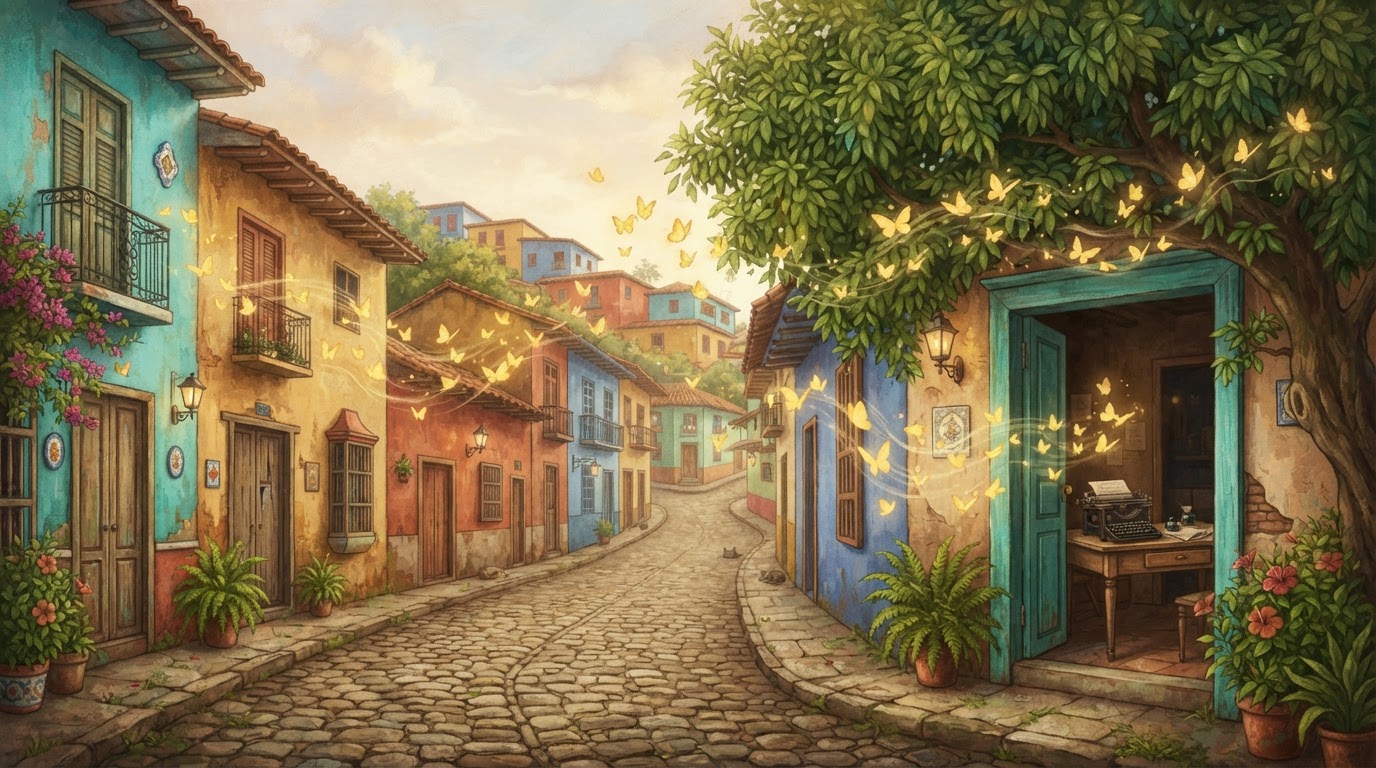
Gabriel García Márquez, known across Latin America simply as “Gabo”, wrote about a fictional town where it rains for nearly five years, a woman ascends to heaven while folding laundry and yellow butterflies follow a lovesick mechanic. Readers called the style magical realism. García Márquez insisted he was simply describing reality as people in the Caribbean experienced it. His masterpiece, One Hundred Years of Solitude, became one of the most celebrated novels of the twentieth century and showed the world that literature from the Global South could stand at its centre.
At a glance
- Born: 6 March 1927, Aracataca, Colombia
- Died: 17 April 2014, Mexico City
- Field: Literature, journalism
- Known for: One Hundred Years of Solitude (1967); Love in the Time of Cholera (1985); Nobel Prize in Literature 1982
A grandparents’ house
García Márquez spent his early childhood with his maternal grandparents in Aracataca, a small town in Colombia’s banana-growing region near the Caribbean coast. His grandfather, a retired colonel and veteran of Colombia’s civil wars, told him stories of battles and politics. His grandmother told stories of ghosts and omens in a calm, matter-of-fact voice. He later said that this tone, telling extraordinary things as if they were perfectly normal, became the key to his writing.
The region also carried darker memories. In 1928, Colombian troops fired on striking workers at banana plantations run by the American United Fruit Company. Many people were killed, though the exact number remains disputed. The massacre, and the way it was erased from official memory, became a central episode in his later novel.
A journalist first
García Márquez studied law in Bogotá but abandoned it for journalism. He wrote for newspapers in Cartagena, Barranquilla and Bogotá, and worked as a foreign correspondent in Europe. In 1955 he published a series of articles about a sailor who survived ten days adrift at sea. The articles revealed that the naval ship had been carrying smuggled goods, embarrassing the military government, and García Márquez had to stay abroad.
He always considered himself a journalist as much as a novelist. In 1994 he founded a foundation in Cartagena to train young Latin American journalists, which continues his work today.
One Hundred Years of Solitude
His early novellas, including No One Writes to the Colonel (1961), won him admirers but few sales. Then, living in Mexico City, he had an idea for a novel about his childhood world. He spent around 18 months writing, while his wife Mercedes kept the household going on credit. According to his own account, when he posted the manuscript to the publisher in Buenos Aires, they could afford to send only half at first.
One Hundred Years of Solitude was published in 1967. It tells the story of seven generations of the Buendía family in the town of Macondo, from its founding to its destruction. Civil wars, foreign companies, massacres, love affairs and miracles unfold in a single sweeping narrative. The book was an instant success across Latin America and has since sold tens of millions of copies in dozens of languages.
The Latin American Boom
García Márquez became the most famous figure of what critics called the “Latin American Boom”, alongside writers such as Julio Cortázar, Carlos Fuentes and Mario Vargas Llosa. For the first time, Latin American novels were bestsellers in Europe and North America, and they influenced writers everywhere.
He went on to write The Autumn of the Patriarch (1975), a portrait of a dictator; Chronicle of a Death Foretold (1981); and Love in the Time of Cholera (1985), a story of a love that waits more than half a century. In 1982 he received the Nobel Prize in Literature. In his acceptance speech, “The Solitude of Latin America”, he argued that Europe struggled to understand Latin America because it measured the region by its own standards.
Politics and controversy
García Márquez was a man of the left. His close friendship with Fidel Castro drew criticism from writers who accused him of ignoring human rights abuses in Cuba. At the same time, he used his influence quietly to help secure the release of political prisoners and to support peace efforts between the Colombian government and guerrilla groups. Readers will judge that balance differently.
Last years
He was diagnosed with lymphoma in 1999 and began writing his memoirs. The first volume, Living to Tell the Tale, appeared in 2002. In his final years he suffered from dementia. He died at his home in Mexico City in April 2014, aged 87. Colombia declared three days of national mourning.
Why he matters, and his African echoes
García Márquez wrote about colonial history, foreign companies extracting wealth, civil wars, dictators and the way official history erases ordinary people’s suffering. These themes are familiar to African readers. Many African writers have drawn on similar traditions, blending oral storytelling, myth and political critique. Ben Okri’s The Famished Road, for example, is often compared to his work.
His greatest legacy may be confidence. He showed that a writer from a small town on the edge of the world could write about that town and speak to all humanity. Every reader in Africa who has recognised their own village in Macondo has felt that truth.
Leave a Reply