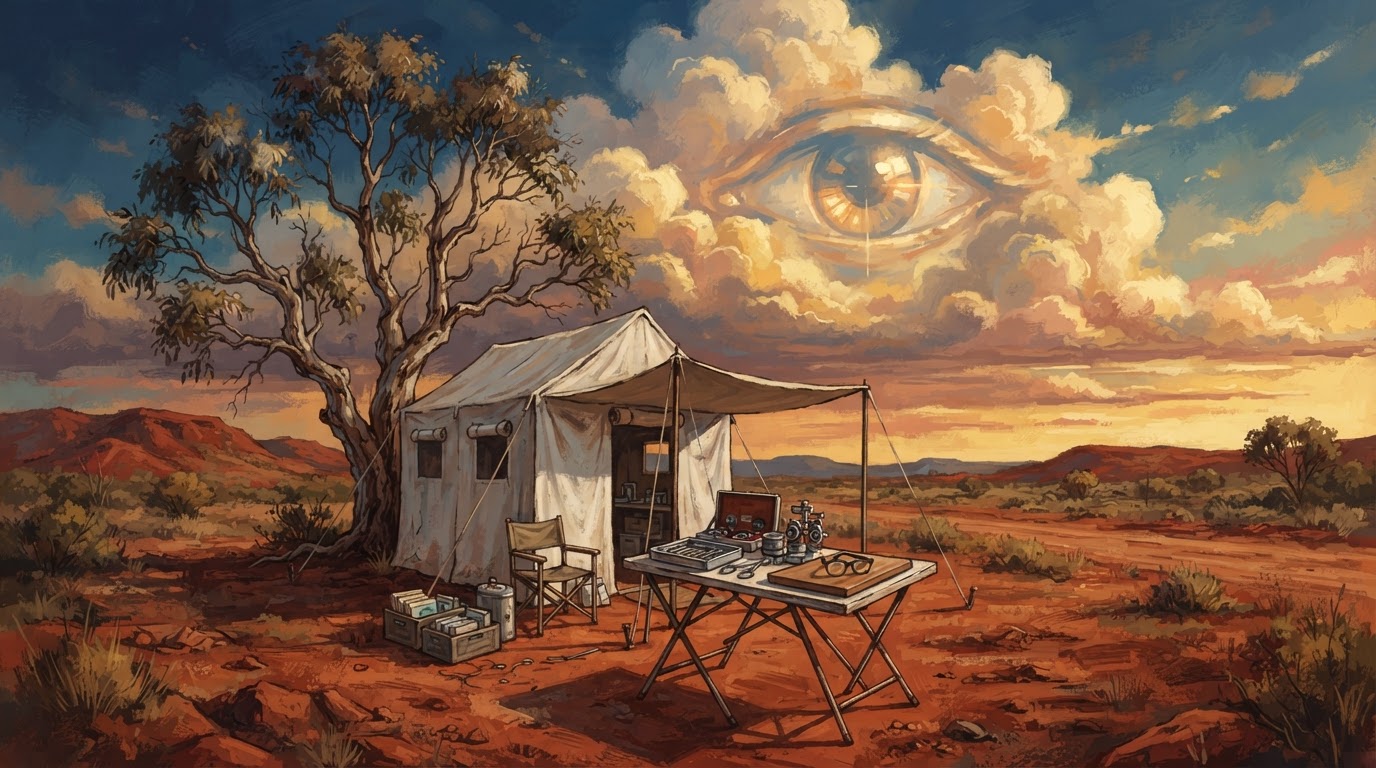
Most blindness in the world can be prevented or cured. Cataracts, the clouding of the eye’s lens, can be fixed with a short operation. Yet for decades millions of people in poor countries went blind simply because they could not get or afford that operation. Fred Hollows, a blunt-speaking eye surgeon from New Zealand, refused to accept that. He took eye care to Aboriginal communities in outback Australia, then to Africa and Asia, where he built factories to make lenses cheaply and trained local people to perform surgery. The foundation he started has helped restore sight to millions.
At a glance
- Born: 9 April 1929, Dunedin, New Zealand
- Died: 10 February 1993, Sydney, Australia
- Field: Medicine, ophthalmology, public health
- Known for: Australia’s National Trachoma and Eye Health Program; low-cost lens laboratories in Eritrea and Nepal; The Fred Hollows Foundation
From mountains to medicine
Hollows grew up in New Zealand, the son of a railway worker. He briefly studied for the church before switching to medicine at the University of Otago. He was a keen mountaineer, a political radical and a man who spoke his mind, often with colourful language. After training in ophthalmology in Britain, he moved to Sydney in 1965 to lead the eye department at the University of New South Wales and Prince of Wales Hospital.
Outback Australia
In the early 1970s, Hollows visited Aboriginal communities in New South Wales and the Northern Territory. He was shocked by what he found. Trachoma, a bacterial eye infection that causes scarring and blindness and had largely disappeared from wealthy countries, was widespread. Cataract blindness was common. Aboriginal Australians were living with eye diseases at levels that would never have been accepted among white Australians.
He worked with Aboriginal community leaders and helped establish the Aboriginal Medical Service in Redfern, Sydney, one of the first community-controlled health services in Australia. From 1976 to 1978 he led the National Trachoma and Eye Health Program. Teams travelled to hundreds of remote communities, examining more than 100,000 people and treating tens of thousands for trachoma. The programme documented the scale of the problem and pushed health authorities to act.
Eritrea
In the 1980s, Hollows turned his attention to the developing world. He visited Eritrea in 1985, while it was still fighting a war of independence against Ethiopia. He was impressed by the Eritrean liberation movement’s self-reliance and its commitment to training local people. He saw a chance to apply his ideas: train local health workers to perform high-quality cataract surgery, and produce the artificial lenses needed locally instead of importing them at high prices.
At the time, intraocular lenses, which replace the clouded natural lens, cost well over US$100 each in Western markets, far beyond the reach of most patients in Africa. Hollows’ vision was to make them for a few dollars. After his death, laboratories were built in Eritrea and Nepal that produced high-quality lenses at a fraction of the previous cost, transforming the economics of cataract surgery across poorer countries.
Nepal and beyond
In Nepal, Hollows worked with the young Nepalese surgeon Sanduk Ruit, who refined a fast, low-cost cataract technique that has since been used to restore sight to huge numbers of people. Hollows also worked in Vietnam and elsewhere, training surgeons and setting up eye services.
Racing against time
In 1989 Hollows was diagnosed with cancer. He spent his final years working even harder, travelling, operating and raising money. In 1992, with his wife Gabi Hollows and colleagues, he established The Fred Hollows Foundation to continue his work. He died in Sydney in February 1993, aged 63. He was given a state funeral, and he was named Australian of the Year in 1990.
Hollows was not a saint and never pretended to be. He could be rude, stubborn and impatient with bureaucracy. But his impatience had a purpose: he believed people were going blind needlessly every day while institutions moved slowly.
Why he matters
According to the World Health Organization, at least a billion people worldwide live with a vision impairment that could have been prevented or has not yet been addressed. Africa carries a heavy share of this burden, with cataract and trachoma still major causes of blindness. Trachoma remains endemic in parts of East and West Africa.
Hollows’ approach offers a model that remains relevant: train local people, reduce costs through local production, and treat health as a right rather than a privilege. The foundation that bears his name continues to work across Africa, including in Ethiopia, Eritrea, Kenya and Rwanda. Every person who sees again after a short operation is part of his legacy.
Leave a Reply