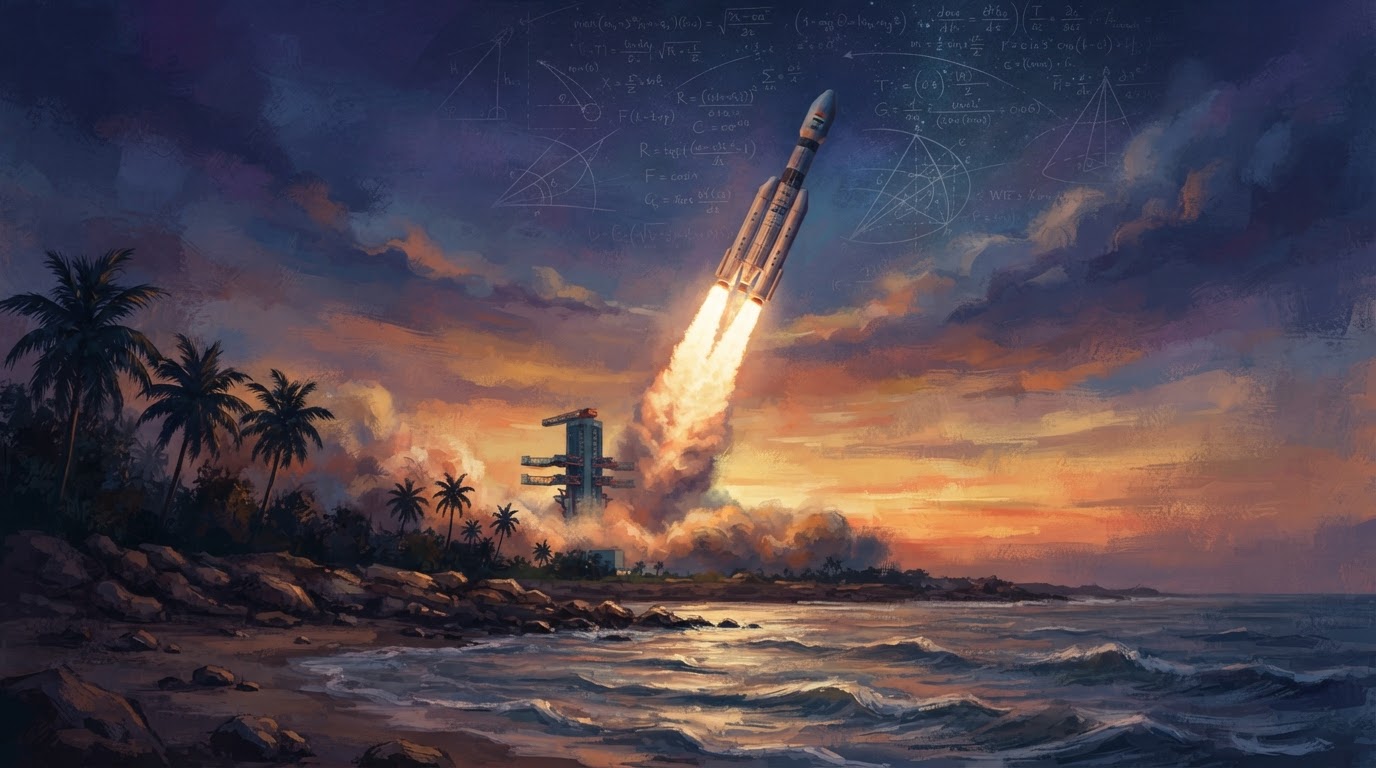
Avul Pakir Jainulabdeen Abdul Kalam grew up in a modest home on a small island, selling newspapers to help support his family. He became one of India’s most important scientists, guiding its space and missile programmes, and later served as its president. But the role he loved most was teacher. Millions of young Indians, and many young people across the developing world, saw in him proof that talent and hard work could overcome a humble start.
At a glance
- Born: 15 October 1931, Rameswaram, Tamil Nadu, India
- Died: 27 July 2015, Shillong, Meghalaya
- Field: Aerospace engineering, science policy, education, politics
- Known for: India’s first satellite launch vehicle; 11th President of India (2002–2007); author of Wings of Fire
A small island town
Kalam was born into a Tamil Muslim family on the island of Rameswaram, a Hindu pilgrimage town off India’s southern coast. His father owned and rented out boats and was also the imam of a local mosque. The family was not wealthy, and young Kalam delivered newspapers before school to earn money.
He later wrote warmly about growing up in a town where Hindus and Muslims lived side by side, and about teachers who encouraged his curiosity. He was fascinated by birds in flight, and that fascination led him to study physics and then aeronautical engineering at the Madras Institute of Technology.
Building India’s space programme
Kalam’s dream was to be a fighter pilot. He narrowly missed selection for the Indian Air Force, finishing just outside the places available. Instead, he joined India’s Defence Research and Development Organisation in 1958, and in 1969 moved to the Indian Space Research Organisation.
At ISRO, he was project director of India’s first indigenous satellite launch vehicle, the SLV-III. The first attempt in 1979 failed. Kalam later recalled how his boss, Satish Dhawan, took responsibility for the failure in front of the press, and then, when the launch succeeded in July 1980, let Kalam take the credit. He said it taught him the most important lesson in leadership. The successful launch put the Rohini satellite into orbit and made India one of a small number of countries able to launch its own satellites.
Missiles and a contested legacy
From the 1980s, Kalam led India’s Integrated Guided Missile Development Programme, which produced missiles such as Agni and Prithvi, earning him the nickname “Missile Man of India”. As chief scientific adviser to the government, he also played a central role in India’s nuclear tests in 1998.
That part of his career is viewed differently depending on where one stands. Many Indians saw it as building national security and self-reliance. Peace campaigners and neighbouring countries saw it as feeding a dangerous arms race in South Asia. Kalam himself argued that strength was necessary for peace. Readers can weigh that argument for themselves; what is not in dispute is the scale of the scientific institutions he helped build.
Science for everyday life
Kalam was also interested in applying advanced technology to ordinary problems. He worked with cardiologist Soma Raju on a low-cost coronary stent, sometimes called the Kalam-Raju stent, to make heart treatment more affordable in India. He also supported the development of lightweight callipers for children with polio, using materials from missile research to replace heavy metal braces.
The People’s President
In 2002 Kalam was elected President of India with support from across the political spectrum. India’s presidency is largely ceremonial, but Kalam made it his own. He opened the presidential palace to the public, answered emails from children and travelled tirelessly to schools and universities. He became known as the “People’s President”.
He set out a vision, called “India 2020”, for the country to become a developed nation through education, technology and rural development. He talked to students about dreaming big, working hard and serving their communities. His autobiography, Wings of Fire (1999), became a bestseller and remains widely read by Indian students.
Teaching to the last
After leaving office in 2007, Kalam returned to teaching, lecturing at universities across India. On 27 July 2015 he collapsed while giving a lecture at the Indian Institute of Management in Shillong, and died shortly afterwards, aged 83. It seemed fitting that his last moments were spent in front of students.
He never married and owned few possessions. When he died, his belongings reportedly included books, a few clothes and a veena, a stringed instrument.
Why he matters
For countries in the Global South, Kalam’s story carries a powerful message: advanced science is not reserved for rich nations. With investment in education and institutions, a developing country can build space programmes, medical technology and world-class engineering capacity. Africa’s growing space agencies, including those in Nigeria, Egypt, Kenya and South Africa, are pursuing a path India travelled.
His deeper legacy, though, is as a teacher. Kalam believed every young person carried potential that society had a duty to unlock. He spent his final years trying to unlock it, one classroom at a time.
Leave a Reply