Mohandas Karamchand Gandhi was born in the nineteenth century, but his greatest impact came in the twentieth. In the late 1920s and 1930s he turned the campaign for Indian independence into a mass movement of millions. His central idea, that ordinary people could defeat powerful governments through organised, disciplined non-violence, travelled far beyond India. It shaped the American civil rights movement, anti-colonial struggles in Africa and protest movements around the world.
At a glance
- Born: 2 October 1869, Porbandar, western India
- Died: 30 January 1948, New Delhi
- Field: Politics, civil resistance, ethics
- Known for: Leading India’s independence movement; developing satyagraha (non-violent resistance); the 1930 Salt March
Early life and South Africa
Gandhi grew up in a merchant-caste Hindu family in Gujarat. He trained as a lawyer in London and, struggling to build a career in India, accepted a job in South Africa in 1893. Soon after arriving, he was thrown off a first-class train compartment at Pietermaritzburg because he was not white. He later described that cold night on the station platform as a turning point.
Gandhi spent more than 20 years in South Africa, organising the Indian community against discriminatory laws. There he developed satyagraha, which he translated as “truth-force”: the deliberate, peaceful breaking of unjust laws and the willing acceptance of punishment, in order to shame the authorities and win over public opinion.
A difficult truth for African readers
Gandhi’s South African years also include writings that many Africans find painful. In that period he campaigned for the rights of Indians, not of Black Africans, and he sometimes described Black South Africans in openly racist language, arguing that Indians should not be classed alongside them. Historians debate how far his views changed later in life. In 2018, a statue of Gandhi was removed from the University of Ghana after students and staff protested over these writings. Any honest account of his life must include this.
Return to India
Gandhi returned to India in 1915. He travelled widely, dressing simply and living among ordinary people. In 1917 he helped indigo farmers in Champaran, Bihar, resist exploitative planters, his first major campaign in India. By the early 1920s he led the Indian National Congress and launched a nationwide non-cooperation movement, calling on Indians to boycott British goods, courts and schools.
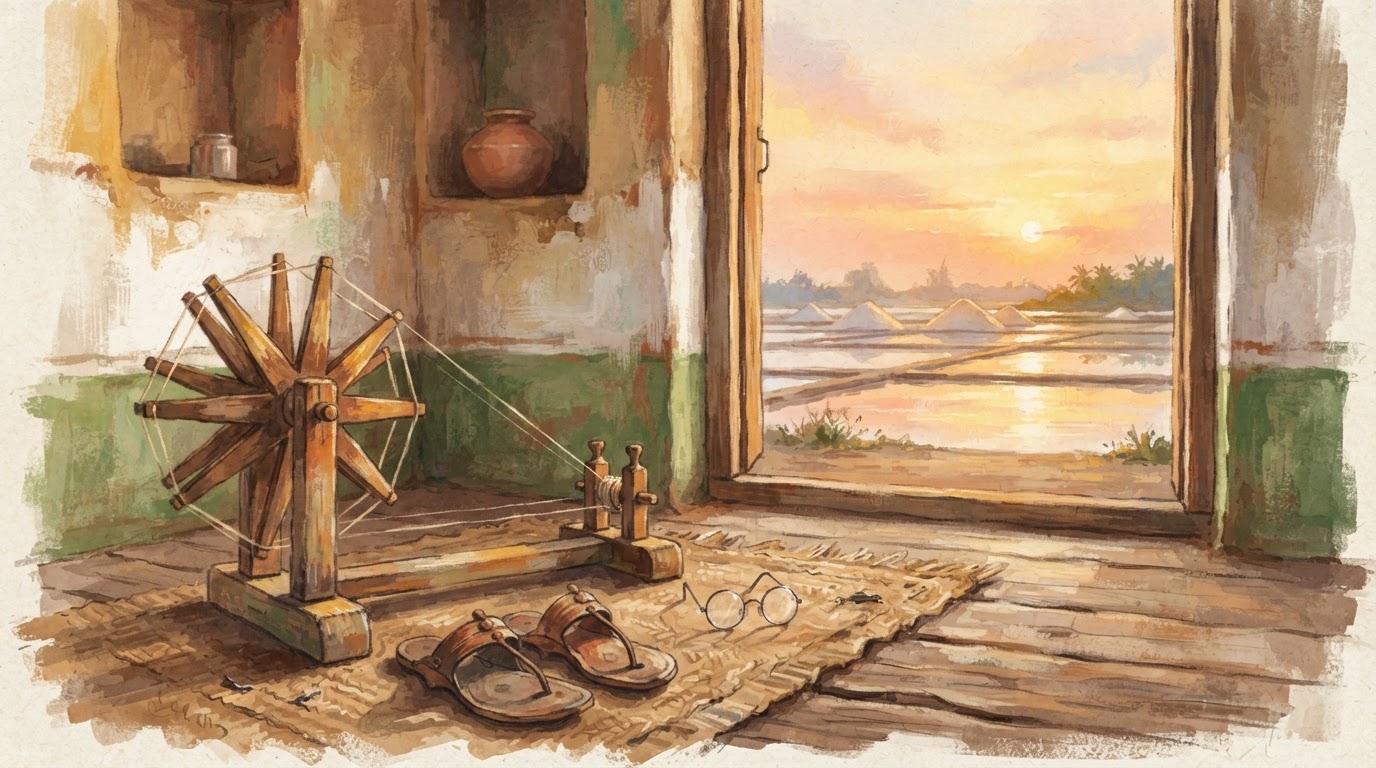
He promoted khadi, hand-spun cloth, as a symbol of self-reliance. The spinning wheel became the emblem of the movement, a direct challenge to the British textile industry that had wrecked India’s handloom economy.
The Salt March
Gandhi’s most famous campaign came in 1930. The British held a monopoly on salt and taxed it, hitting the poorest Indians hardest. On 12 March, Gandhi set out from his ashram near Ahmedabad with a small group of followers and walked about 240 miles to the coastal village of Dandi. Crowds joined him along the way. On 6 April he picked up a handful of salty mud from the shore, breaking the law.
The act sparked civil disobedience across India. Tens of thousands of people were arrested, including Gandhi. International newspapers reported on peaceful protesters being beaten by police, and the moral standing of British rule suffered badly. The march showed how a simple, symbolic act could mobilise a whole country.
Quit India and independence
In 1942, during the Second World War, Gandhi launched the “Quit India” movement, demanding an immediate end to British rule. He and the Congress leadership were imprisoned for much of the war. By 1945, Britain was exhausted and Indian independence was only a matter of time.
Independence came on 15 August 1947, but not in the form Gandhi wanted. British India was partitioned into India and Pakistan. The division triggered horrific violence between Hindus, Muslims and Sikhs, and up to a million people may have died, with many millions displaced. Gandhi spent the period of independence not celebrating in Delhi but in riot-hit areas, fasting and pleading for peace.
Assassination
On 30 January 1948, Gandhi was shot dead at a prayer meeting in New Delhi by Nathuram Godse, a Hindu nationalist who believed Gandhi had been too accommodating towards Muslims and Pakistan. He was 78.
His influence on Africa and the world
Gandhi’s methods inspired leaders across the colonised world. Kwame Nkrumah described his campaign of “positive action” in the Gold Coast as drawing on non-violent principles. Kenneth Kaunda in Zambia and Albert Luthuli in South Africa admired Gandhi’s approach. Martin Luther King Jr. travelled to India in 1959 and described Gandhi as the guiding light of his technique of non-violent social change.
Mandela, who turned to armed struggle when peaceful protest was met with massacre, still spoke of Gandhi with respect, noting that non-violence works best when your opponent has a conscience that can be reached. That debate, about when non-violence is possible and when it is not, continues today.
Why he matters
Gandhi demonstrated that the power of governments rests on the cooperation of the governed, and that when people withdraw that cooperation together, even an empire can be forced to retreat. His tools, from boycotts and marches to hunger strikes and civil disobedience, remain part of every protest movement’s playbook.
He was also a flawed human being, as his South African writings show. Remembering him honestly, as both an extraordinary strategist of freedom and a man shaped by the prejudices of his time, is more useful than treating him as a saint. The ideas he developed outlived his own limitations, and they have been used by people he never imagined, including the African freedom fighters he once overlooked.
Leave a Reply